RC5 56bit Encryption Challenge

UNB Cryptography LOGO


The
UNB Crytography Group helped in the international effort to crack the RC5 56bit encryption algorithm. Using a large number of computers working together in a distributed computing system, and using a brute force attack (trying all possible keys), the distributed.net cracked the RC5 algorithm in RSA's third RC5 challenge.

If you are interesting in getting more information about the RC5 challenge click
here.

RC5 56bit RESULTS


The distributed.net effort to decrypt the encoded message required massive computing power, harnessed by utilizing the idle, or otherwise unused computing power from ordinary office and home computers. Combined, these machines managed to evaluate 47% of the keyspace, or 34 quadrillion keys, before finding the winning key. At the close of the contest there were over 4000 active teams processing over 7 billion keys each second at a combined computing power equivalent to more than 26 thousand high-end personal computers. The work was performed entirely using consumer PCs during off-hours or otherwise idle time. Add them all together, however, and you have the world's largest computer.

The winning key was found by Peter Stuer, working for the STARLab Bovine Team coordinated by Jo Hermans and centered in the Computer Science Department (DINF) of the Vrije Universiteit in Brussels, Belgium.

Project statistics:

          Start of contest:                     January 28, 1997
          Start of distributed.net effort:      March 20, 1997
          End of contest:                       October 19, 1997
              
          Size of keyspace:                     72,057,594,037,927,936
          Number of "blocks":                              268,435,456
          Number of keys in one "block":                   268,435,456
          Peak keys/day:                           600,246,644,113,408
          Peak keys/second:                              7,200,000,000

      The unencrypted message:  "It's time to move to a longer key length"


      Computing equivalents:

          Distributed.net is equivalent in processing power to:

          14,685 Intel Pentium Pro 200 processors
          13,362 Motorola PowerPC 604e/200 processors
          116,326 Intel 486DX2/66 processors
          58,163 Intel Pentium 133 processors


      Perspective:

          distributed.net could compromise 46-bit RC5 in under one hour.

RC5 56bit STATISTICS


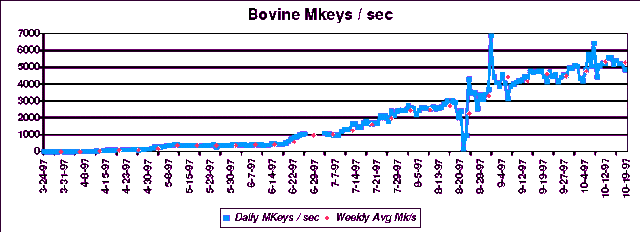
RC5-56 Rate


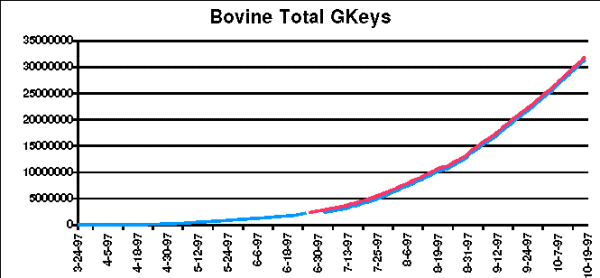
RC5-56 Total


Return to
Distributed Computing Projects Home Page